Consumers love the internet and the internet loves its consumers. What made the internet what it is today? Is it its multi-billion users or is it the platforms that make it? It's a symbiotic relationship.
As developers of the internet (literally and figuratively) we feel passionately about how we can leverage this beautiful infrastructure. As its users we only challenge its existing relationships, driving even more innovation. The term internet is used as an all encompassing term for the physical infrastructure, the services it offers and the global behemoth of a platform that it is. It's beautiful. The internet's removal of physical barriers is driving creativity and empowering the creation of niche products and services. We should be nothing but excited for what lies ahead.
Increasingly more day to day utilities are onboarding to the web. Being online is not just about having an internet connection and a web page. It's about moving critical functionalities like banking, education, grocery shopping, entertainment etc. from their physical manifestations to be accessible on the screen that you're reading this article on — consequently making them widely accessible, pushing convenience one step further, and reducing our trips out of the house. Today we face a shortage of time for ourselves, our day to day chores and for those who are a part of our lives. At the same time we are able to offload many tasks on the massive catalog of services the internet has to offer, move our social lives to a screen and yet be more hyper connected than ever. This offloading of day to day tasks leaves us with more time than ever for leisure, personal well-being and growth.
The internet offers us options to fill the time we gained. 280 character tweets, 60 second TikTok videos, 2 minutes to an Uber Eats order, a 15 minute tele-consultation with a doctor or a 30 minute class on Udemy. We are able to fit in a lot of tasks that took much longer into short bursts of time. On the other side of this, we only need an internet connection to find new opportunities or gigs — a 15 minute slot to provide remote consultation to a sick patient, 20-30 minutes to deliver meals or drop a passenger, or just 10 minutes to create content to publish on Instagram. Life has become only more momentary and time has become only more valuable. What we do with this time is what will spur the next generation of the internet — in fact, it already has.
The internet has manifested itself as a means to purpose and survival, apart from just a medium of consumption. It has enabled personal freedom, freedom of choice and freedom from the physicality of location. We are going to explore how this new dawn of the internet has enabled a generation of billions of individual micro brands. There are two parts to this internet-driven economy: the creators and the consumers.
Creators and Consumers
Creators encompass all sorts of individuals generating content that can be consumed, offering services that can be availed or creating products that can be purchased — YouTube and TikTok video creators, tele-doctors, online educators, or artists showcasing their creations on Instagram or Displate. Mind you, we are not including massive tech firms like Amazon, Facebook, Twitter. They provide the platform that people can leverage.
Consumers on the other hand are the ones consuming the content or availing these service offerings. They are not just people who entertain themselves and shop online — they use the internet as a platform for their personal and professional growth. Let us go over how we can leverage this hyperconnected internet-conomy, starting from the consumer's perspective.
- Learning to Cook? YouTube has a host of chefs to learn and savor global cuisines.
- Learning to Repair things? TikTokers can guide you one step at a time.
- Eager Learner? Join Udacity, Masterclass or Coursera and learn from the experts.
- Avid Reader? Countless blogs at your fingertips.
- Movie Buff? Netflix has a decade worth of content to watch.
The internet not only offers us convenience and entertainment but it has made us life long students. The playing field has just been leveled with equal access to resources for learning, entertainment and day to day operations. No longer do we need to be bound to educational institutions or institutions of formal learning. All that is needed is a phone and an internet connection — and learning to learn fast. Pursuing your own small business, idea, or hobby and converting it into a means of survival has never been more possible than it is today.
- Missing employee management skills? Take a business course or even a business degree at your own convenience over the internet.
- Need to start marketing your idea? Twitter, Substack, YouTube, Instagram are just a few of the resources.
- Selling your products online? Etsy, Amazon, Facebook Marketplace attract massive customer bases.
If it is possible to learn anything from anywhere, do college degrees act as mere credentials — just like an entry stamp to a night club? This is not to say attending college is not useful. It's to emphasize the plethora of free resources available on the web to do the same, with more diversity than ever. An interesting point I read on another blog:
"The biggest thing most people get from college is a bridge to learn how to grow up. It is an excellent path to learning to be on your own and become an adult."
Democratization of Work
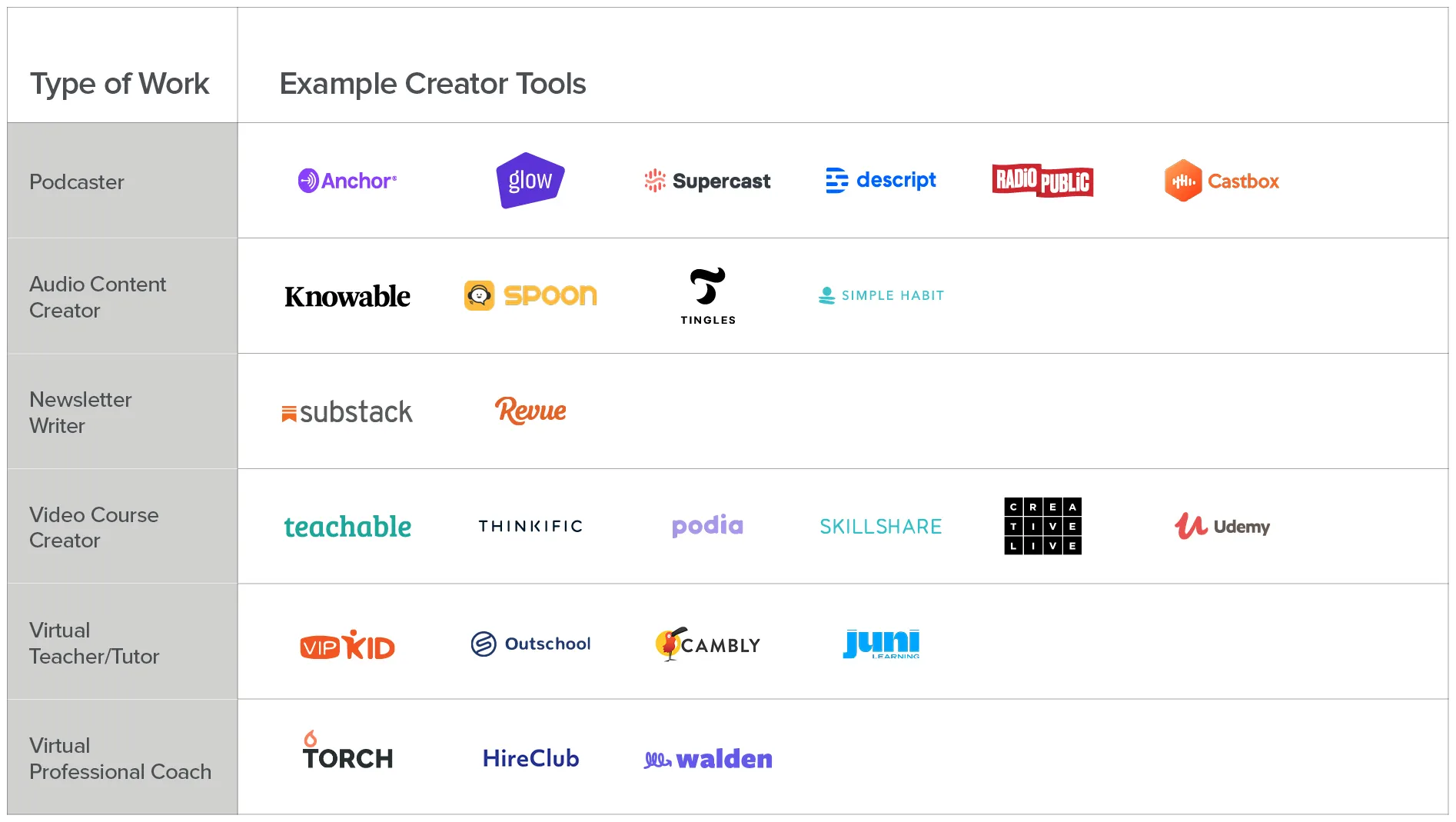
With the problem of education and gaining useful skills solved, we come to putting the skills to use — democratization of work. Democratization in the sense of something being widely available and equally accessible. Here are some ideas for the new age worker:
- Adept Gamer? Broadcast and entertain viewers on Twitch.
- Like Accounting and Finance? Become a financial advisor on Mint/Quickbooks.
- Doctor? Teladoc can help you offer consulting from your couch.
- Enjoy Teaching? Create and sell your own courses on Podia or Teachable.
- Prolific Writer? Start a paid newsletter on Substack.
- Lawyer? Join LegalZoom as an Attorney at will.
- Still have some spare time? Uber driver to help people get around or deliver meals.
Work not in its traditional sense of being on someone else's payroll, having your identity tied to another entity. Instead work as your self-honed passion, as a hobby turned into a source of livelihood and work as a means of expression. One may or may not become excessively wealthy but one can certainly achieve a good way of life. Individual work is not something that is new — small businesses have existed for ages. Just like the age old barter system where specialized craftsmen and craftswomen exchanged goods and services, we are seeing a 21st century manifestation of it.
We are witnessing a shift to offering content and services at an individual level, and micro-brands that develop around those individuals. Consumers tend to relate to creators more at a personal level as opposed to larger brands, due to the way the service is being offered. The proliferation of these micro brands poses a threat to larger organizations by taking a piece of their pie. Not all professions can be easily dispersed over the internet — professions that require extreme in-person care will continue so, and some would be replaced by robots but operated by humans sitting in their pajamas. So once again all that the pajama person gained is more time.
This conversation can further deviate into the world of cryptocurrency and how it could enable a boundary-less world where anyone in any part of the world could hire someone in another part — a seamless exchange of services using any form of a digital native decentralized currency.
Looking ahead
As individuals thrive and larger institutions take a back seat, they certainly will not cease to exist. After all, they are the ones building these platforms for individuals to flourish. Going forward we will see more and more platforms that aggregate people who generate content, provide services and that people will use. The abundance of content in the internet age has meant that the success of online media platforms has depended on their ability to help users discover it.
People appreciate the freedom that comes with making it in the world by themselves. However, people also thrive when they cooperate. A herd motivated by a common goal will continue to join forces towards the common purpose. That is how new organizations and platforms will continue to come up, inspiring the next generation of the internet and its consumers. We empower the internet and the internet empowers us.
Future of work is remote. Future of work is independence. Only if you are connected to the Internet.